If it didn't happen so many times, I would have not noticed it. But it was the third time during this trip and I figured it was something worth mentioning...
As you may know, the way to get around in many developing countries is a shared taxi. It is usually a seven seated mini van that is filled with ten people or more.
Skinny? Age 12 or younger? Last one on? You are sitting on a lap.
The trick behind these shared taxis is to be on of the last ones on. If you are the first one, you may have to wait 30 minutes or more until the taxi scout find more people to fill up the rest of the seats. I learned this the hard way after being hurriedly scooted into a taxi van in Ghana with the utmost urgency, only to learn that I would be sitting in the nearly empty taxi with no air conditioning in hundred degree weather. In my trips to Africa I developed a skill for hanging around the taxi, ordering tea, and spending time until the last minute when I could jump onto a nearly full taxi (but not the last one, see above) and take off. This skill eventually developed into a unconscious habit.
So while here in India I have stepped away from a taxi for a minute to get a Chai, or snack and come back to the taxi to see it nearly full. I find myself thinking where did these people all come from. I can not convey how uncanny it is to experience. I felt like I blinked and there was a minivan full of people. To explain this phenomenon I subconsciously searched for frames of reference.
While here I had been pondering how a country like India gets so populace. Could it be the abundance of food? The lack of genocidal wars? Early establishment of centralized government? So, following along this mind direction, for a brief second I thought, India is so full of people, that shared taxi's just fill up in an instant. However, I was not satisfied with this simplistic explanation. I looked at the contented of the taxi and there was a diversity of ages. Small kids, teenagers, people my age and my parents age. Then as I saw their behavior, they all seemed to know each other. This was all the observation I needed to conclude that the reason shared taxis fill up so quickly is that entire families are getting on at once. Furthermore, they are not American families consisting of two parents and a kid, but Asian families that consist of grandma, grandpa, uncles, cousins....
For the remainder of my time here, I will be sure to grab a seat while I can get it.
Intercultural Tip: Unconscious behavior was once a conscious response to a particular circumstance. When circumstances change, your unconscious behavior will need to be brought to your conscious.
Friday, May 6, 2011

Sunday, May 1, 2011
The Official and the Commercial
With my work with refugees or anyone visiting my country, I often ask about first impressions. To get beyond surface impressions of burgers and traffic I usually pose the question this way; "So you know you are in the United States when you fly over land or get off the plane. You know this cognitively, but then there is a time when you really realize with your full body and mind that you are in a new place. Have you had this experience?" This question usually gets at the heart of values and underlining assumptions.
So, if I were to answer the question myself about my first impression of India I would have to tell the story of my first few minutes in the airport. So, of course, I knew I was in India when I got off the plane and saw lots of Indian looking people, attendants in the bathroom, directional signs written in Hindi. But, the point where I really said to myself, "this is it, you are in India" was right after left customs. After presenting my passport and answering the usual questions of the boarder guard I walked forward to be right in a duty free shop. At no point had I decided to go into a duty free shop, in fact I thought I was still in the official/governmental portion of the airport. It was almost like I was transported from officialdom, where paperwork and uniforms are the norm to a land filled with duty free whiskey and beautiful women in smart dresses.
Well I wasn't transported, but the reason it seemed like it was because there was no wall or distance separating the customs counter with the duty free shop. Usually in the U.S airports are built so that there is a clear zone of commercialism and officialdom. For those Americans, imagine walking out of the security gauntlet directly into a store selling those inflatable airplane pillows and luggage.
Also, I thought which business owner gets this extremely favorably placed store. Did the business person have to pay high rent or was he or she just very well connected with the local government official who was responsible for building the airport. Is this official/commercial boundary-less duty free store a manifestation of how business and politics merge in India?
But need there be boundaries? Perhaps this idea that there ought to be a boundary between official space and commercial space is an American or Western notion. Perhaps even the categories of official and commercial are cultural constructs I am imposing.
Intercultural Tip: Be mindful of surprises within new cultures. Let these surprises provide an affective impetus to explore your own culturally constructed categories.
So, if I were to answer the question myself about my first impression of India I would have to tell the story of my first few minutes in the airport. So, of course, I knew I was in India when I got off the plane and saw lots of Indian looking people, attendants in the bathroom, directional signs written in Hindi. But, the point where I really said to myself, "this is it, you are in India" was right after left customs. After presenting my passport and answering the usual questions of the boarder guard I walked forward to be right in a duty free shop. At no point had I decided to go into a duty free shop, in fact I thought I was still in the official/governmental portion of the airport. It was almost like I was transported from officialdom, where paperwork and uniforms are the norm to a land filled with duty free whiskey and beautiful women in smart dresses.
Well I wasn't transported, but the reason it seemed like it was because there was no wall or distance separating the customs counter with the duty free shop. Usually in the U.S airports are built so that there is a clear zone of commercialism and officialdom. For those Americans, imagine walking out of the security gauntlet directly into a store selling those inflatable airplane pillows and luggage.
Also, I thought which business owner gets this extremely favorably placed store. Did the business person have to pay high rent or was he or she just very well connected with the local government official who was responsible for building the airport. Is this official/commercial boundary-less duty free store a manifestation of how business and politics merge in India?
But need there be boundaries? Perhaps this idea that there ought to be a boundary between official space and commercial space is an American or Western notion. Perhaps even the categories of official and commercial are cultural constructs I am imposing.
Intercultural Tip: Be mindful of surprises within new cultures. Let these surprises provide an affective impetus to explore your own culturally constructed categories.
Monday, August 2, 2010
Politics, Religion and other inpolite converstations
In the second week of attending the Summer Institute of Intercultural Communication in Portland Oregon, my friend and I stopped into a 7-11 to pick up some Starbucks Double shots. There I saw a guy who I guessed was from Ethiopia. I said "Salam, endeminea" which means "hello, how are you?" in Amharic. His face lit up and as he rang up the Doubleshot, we started discussing his area of birth and where he grew up. He mentioned how he was born in Eritrea, but raised in Gonder, Ethiopia. He acknowledged the difference in political boundaries between the two countries, but clearly stated that Eritrea and Ethiopia are the same people and should not have sacrificed so many lives in the war to create the political boundary.
Reflecting on this conversation I thought of other boundaries. Like the boundaries of polite conversation. "A gentleman does not discuss politics, religion or money,"I remember learning. Somehow these boundaries were lowered by just by taking a guess and saying some words in Amharic. Perhaps if I would have started the conversation more politely and not assumed the man was from Ethiopia, we would not have had such a meaningful brief interaction.
After a few hours my friend and I returned to the 7-11 for some renown Oregon beer. This time I went directly to the clerk and asked if the 7-11 carried tej (famous Ethiopian honey wine). Even though I knew that 7-11 does not carry Ethiopian tej, I figured I would playfully respect cultural uniqueness. To pronounce tej is difficult, one must project the t almost like you are saying tisk tisk tisk. So by accomplishing this feat of Ahmaric pronunciation and by acknowledging a familiar and sociable drink, the clerk was even more impressed. His eyes lit up and by the time we were checking out we crossed another boundary of polite conversation.
"You went to Orthodox Church right."-Clerk
"Yes, I went to one outside. I stood on the left side"-Me
"You know this one hummm la haaa la hum de ha de daa"-Clerk singing a church song.
"No, I don't think..."-Me
"Yes you know it, da de hum de ha de ha de ha"-Clerk
"De ha de ha de ha"-Me trying to follow along
Boundaries! Wow we were already onto religion after discussing politics during my last visit only a few hours earlier.
After paying for the beer and walking to the Summer Institute of Intercultural Communication I felt a feeling of right-path or like I was doing what I should be doing in life. This little interchange with the clerk renewed my sense of self being an interculturalist and payed respect to a portion his clerks identity. The majority of people I meet think of intercultural interaction in the negative. "Don't assume a person with Asian features was born in Asia." "Don't assume people are different than you." "In fact, don't assume anything, because that's a stereotype." I like to think of intercultural interaction in the positive. Like in the words of a famous Portland employer, Just Do It.
Intercultural Tip: Crossing boundaries is not polite, but neither is being an interculturalist.
Reflecting on this conversation I thought of other boundaries. Like the boundaries of polite conversation. "A gentleman does not discuss politics, religion or money,"I remember learning. Somehow these boundaries were lowered by just by taking a guess and saying some words in Amharic. Perhaps if I would have started the conversation more politely and not assumed the man was from Ethiopia, we would not have had such a meaningful brief interaction.
After a few hours my friend and I returned to the 7-11 for some renown Oregon beer. This time I went directly to the clerk and asked if the 7-11 carried tej (famous Ethiopian honey wine). Even though I knew that 7-11 does not carry Ethiopian tej, I figured I would playfully respect cultural uniqueness. To pronounce tej is difficult, one must project the t almost like you are saying tisk tisk tisk. So by accomplishing this feat of Ahmaric pronunciation and by acknowledging a familiar and sociable drink, the clerk was even more impressed. His eyes lit up and by the time we were checking out we crossed another boundary of polite conversation.
"You went to Orthodox Church right."-Clerk
"Yes, I went to one outside. I stood on the left side"-Me
"You know this one hummm la haaa la hum de ha de daa"-Clerk singing a church song.
"No, I don't think..."-Me
"Yes you know it, da de hum de ha de ha de ha"-Clerk
"De ha de ha de ha"-Me trying to follow along
Boundaries! Wow we were already onto religion after discussing politics during my last visit only a few hours earlier.
After paying for the beer and walking to the Summer Institute of Intercultural Communication I felt a feeling of right-path or like I was doing what I should be doing in life. This little interchange with the clerk renewed my sense of self being an interculturalist and payed respect to a portion his clerks identity. The majority of people I meet think of intercultural interaction in the negative. "Don't assume a person with Asian features was born in Asia." "Don't assume people are different than you." "In fact, don't assume anything, because that's a stereotype." I like to think of intercultural interaction in the positive. Like in the words of a famous Portland employer, Just Do It.
Intercultural Tip: Crossing boundaries is not polite, but neither is being an interculturalist.
Tuesday, July 20, 2010
Ethiopia Self
It seems there are many selves that inhabit my body. I have my improvisation self that I use when I am doing improvisational comedy on stage. This is the body where I adapt to change and ambiguity very quickly. I feel the improvisation body when I feel an expanse of chaos opening up around me. My body and tongue moves with the training and discipline of an improviser at the expense of careful reflection and varied interpretation.
Just this week I realized that I have another self that I developed while in Ethiopia. Whereas my improvisation body was trained through classes and refined through practice. My Ethiopia body was trained by the country itself. Countries train your body so that you make sense within the country. To be a little less figurative, people inside countries have facial expressions, gesticulations, and body movements. People reward you through nonverbal communication (smiles, eye contact, ect.) if you conform or at least connect with these non verbal behaviors.
Let me tell a story to ground the explanation in a lived experience. My wife and I were at her company’s diversity themed picnic. Wearing of ethnic dress was encouraged at this picnic. We weren’t sure if we were required to wear our own ethnic dress or just any dress that was strongly identified with an ethnicity, so we chose to wear our Ethiopian clothes. Jessi wore her Oromo dress and I wore my cotton Ethiopian long shirt. We figured that since current research tracing mitochondrial DNA traces (www.fwquestclub.com/welcome_files/papers/dna.pdf) all humanity back to Ethiopia, we had a good claim to Ethiopia’s ethnic dress. As we were walking to our car we saw two Ethiopian ladies shining a bright smile on both Jessi and I. We walked by them with a smile, then were drawn to turn around.
“You are wearing our culture clothes.” A lady said, starting a conversation.
“We just returned from Ethiopia a month ago.” We put out there as a hook for more conversation.
“Where do you live?” An interesting question posed by a man who just arrived to meet the two Ethiopian ladies.
“We are from uptown.” My wife and I respond. Identifying our uptown village pride.
Soon both my wife and I fell into our Ethiopia selves. My personal bubble shrank as I began talking to the male in the group. Jessi started gesticulating expressively. She then sought to explain the traditional medicine we had while sick in Ethiopia. She bent down and picked up a weed that resembled the leaves of medicine we took. As she pointed to the weed, I knew that she picked up right where we left off when in Ethiopia. She would never pluck grass from the ground and gesticulate like she was doing if she were explain something to a native United States-ian. In fact even she wouldn’t do it for a person from outside the US. This form of expressive and improvisational communication was the residual effect of our experience trying to communicate sans-lingua with people in Ethiopia. The accent, skin tone and knowledge that these strangers were from Ethiopia probably triggered the change. Before I know it Jessi was holding hands with the lady while trying to come up with the word for the medicinal plant.
Just this week I realized that I have another self that I developed while in Ethiopia. Whereas my improvisation body was trained through classes and refined through practice. My Ethiopia body was trained by the country itself. Countries train your body so that you make sense within the country. To be a little less figurative, people inside countries have facial expressions, gesticulations, and body movements. People reward you through nonverbal communication (smiles, eye contact, ect.) if you conform or at least connect with these non verbal behaviors.
Let me tell a story to ground the explanation in a lived experience. My wife and I were at her company’s diversity themed picnic. Wearing of ethnic dress was encouraged at this picnic. We weren’t sure if we were required to wear our own ethnic dress or just any dress that was strongly identified with an ethnicity, so we chose to wear our Ethiopian clothes. Jessi wore her Oromo dress and I wore my cotton Ethiopian long shirt. We figured that since current research tracing mitochondrial DNA traces (www.fwquestclub.com/welcome_files/papers/dna.pdf) all humanity back to Ethiopia, we had a good claim to Ethiopia’s ethnic dress. As we were walking to our car we saw two Ethiopian ladies shining a bright smile on both Jessi and I. We walked by them with a smile, then were drawn to turn around.
“You are wearing our culture clothes.” A lady said, starting a conversation.
“We just returned from Ethiopia a month ago.” We put out there as a hook for more conversation.
“Where do you live?” An interesting question posed by a man who just arrived to meet the two Ethiopian ladies.
“We are from uptown.” My wife and I respond. Identifying our uptown village pride.
Soon both my wife and I fell into our Ethiopia selves. My personal bubble shrank as I began talking to the male in the group. Jessi started gesticulating expressively. She then sought to explain the traditional medicine we had while sick in Ethiopia. She bent down and picked up a weed that resembled the leaves of medicine we took. As she pointed to the weed, I knew that she picked up right where we left off when in Ethiopia. She would never pluck grass from the ground and gesticulate like she was doing if she were explain something to a native United States-ian. In fact even she wouldn’t do it for a person from outside the US. This form of expressive and improvisational communication was the residual effect of our experience trying to communicate sans-lingua with people in Ethiopia. The accent, skin tone and knowledge that these strangers were from Ethiopia probably triggered the change. Before I know it Jessi was holding hands with the lady while trying to come up with the word for the medicinal plant.
Tuesday, July 6, 2010
Categorical Imperative, Training, Social Disorders

Now that I am back in the United States, I notice new things about myself. I am more bold with making things work that I would otherwise accept as part of a system. For example, the bus driver said that I didn’t have enough fare for the ride. First I tried to give him some Euros, which was worth more than the fare, then I appealed to his sense of family, “you can give this to your grandson, it is from Europe.” Then I tried appealing to his sense of pity, “please I can’t get the next bus because I would miss my flight.” When I realized that he was not working with me, I just ran off the bus at the stoplight, ran into a dry cleaner I had done business with earlier that day, “please, I am a loyal customer, I need change quick for the bus, that is my bus there, see?” I was able to get change and run back onto the bus, just in time. Upon reflecting on this situation, I wonder if I would have done this had I not spend two months in Africa. You see, if you allow them, different countries train you to operate within them. My experience in Ethiopia taught me that everything is negotiable: Prices, “how much is this traditional Ethiopian Toga? 300? I will offer you 100.” Policies, “The tej bet is now closed” “Please allow me in, I need to try this Ethiopian treasure of yours.” Statuses, “For 200 birr, we will turn this bus into a personal taxi for you if you need it.” Even sides of the road were negotiable. When a wedding was blocking the southbound side of the road, a group of south bound drivers decided on taking the northbound road until we passed the wedding party, essentially negotiating which side of the road could be driven on. Clearly nobody has read the Groundwork for the Metaphysics of Morals where Immanuel Kant declares the categorical imperative which goes something like, “if it is right in one case, it is right in all cases.” This idea of morality is uniquely Western and is not the case in either Asia or as I just learned Africa. Is the rest of the world more willing to negotiate, can they see the systems, processes, interactions, identities as more situation specific? Perhaps in a Western world where systems, infrastructure, mechanics work regularly, it is easier to see things as non negotiable.
The training that countries give you, if you are paying attention are valueable and are useful even when you leave. For example, while sitting here waiting for a flight, I noticed a European accent coming from a mouth of a person sitting next to me. I then realized I had Euros in my pocket that needed trading. I introduced myself to the lady next to me and then traded them at the bank rate. Both of us got a good deal and neither of us had to pay a bank for the transaction fee, which would have been quite steep on a mere 5 Euros. Would I have I thought of this opportunity or been so bold as to take it had I not been trained in negotiation as I had just been in Africa? Would I have thought to myself, “banks are for trading currency, therefore I must find a bank and pay a commission in order to turn my Euros into Dollars.”
One training I received was to save little pieces of rubbish that could be useful later. After a few experiences throwing something away, an empty bottle, a long piece of string, a plastic bag, I realized I could have used them later. I needed to store some liquid while in the village and I wondered why I had thrown away the plastic bottle. I had needed something to tie some clothes together and I wondered why I had thrown it away earlier, ect. So on my way walking to the terminal here now that I am back, just had second thoughts about recycling this little paper bag that contained my bagel. This is a sturdy little plastic bag, it could come in handy. I thought, a split second before I thought, this is what hoarders things. Right, I am throwing this away right now. But the place I was just in had trained me to be resourceful with what I had. This makes me think, is what is termed resourceful in one circumstance, termed a social disability in another circumstance. Maybe all social disabilities are just adaptations to situations that do not exist.
Intercultural Tip: Consider bizarre cultural behavior as an adaptation to situations you have not yet seen.
Thursday, July 1, 2010
Male and Female work
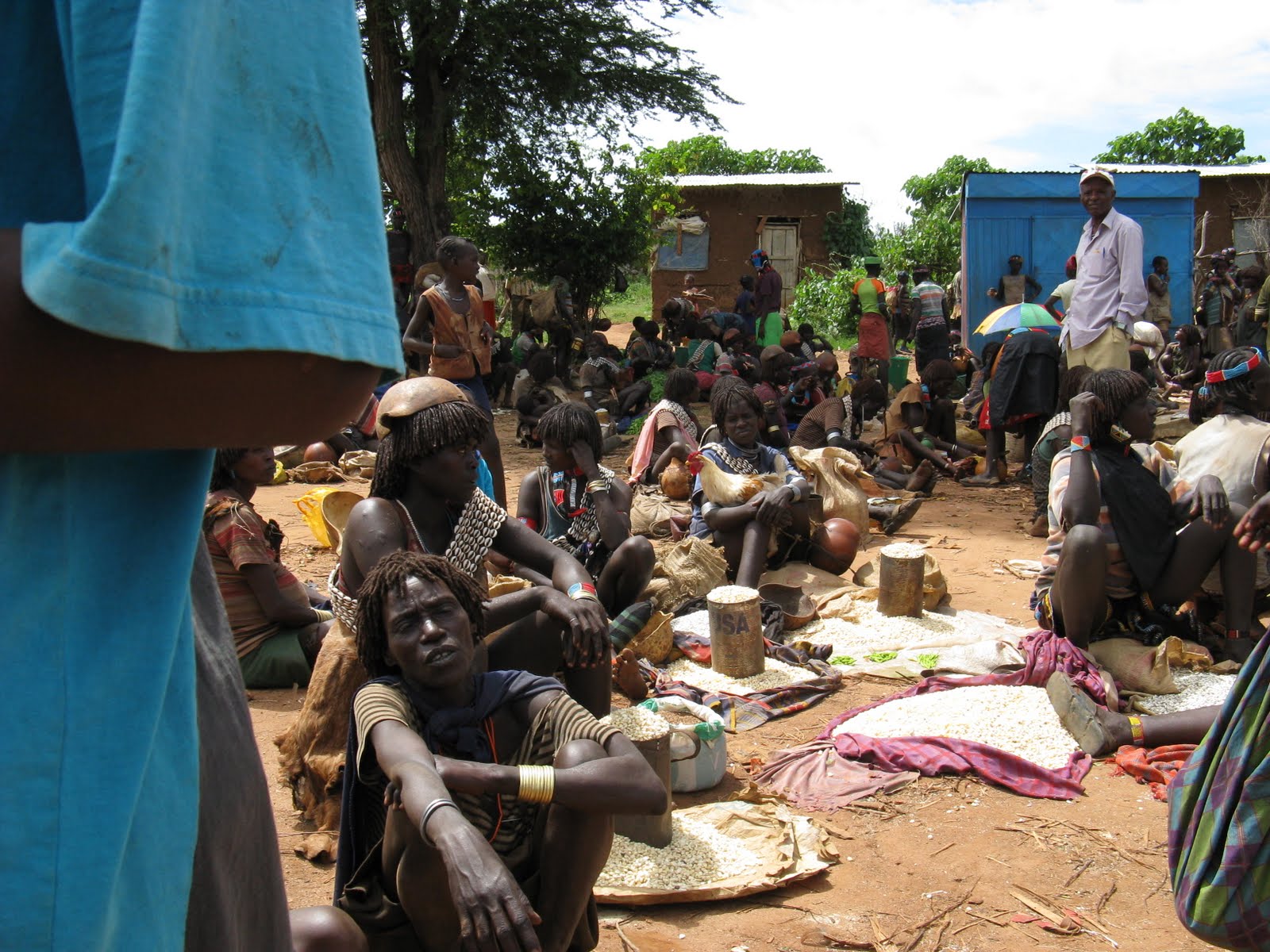


My experience in Africa highlights the difference in gendered work. As I am walking along the streets I see men operating on motorcycles, pounding metal into a usable part, waiting tables and waiting at a taxi stand. I see women sitting behind market stalls, mixing flour into dough and rolling chat leaves into bundles. In my mind I struggle to find the difference in gendered work from what I can see on the street. From what I am seeing on the street (ie. Not what is indicated by larger studies of male and female work life)… Both men and women are doing physically toiling work. Both men and women are earning equally low pay. Both men and women are in various positions of status. Overall there may be gendered differences that I cannot see during my exploration of various towns, villages and cities. However, in contrast, there is one difference that shines out clear as day.
It is related to payout and revenue. Men are largely engaged in activities that have no incremental revenue, but a large payout at a specific point in time. Women are engaged in activities that have steady incremental revenue. For example men at a taxi stand will not make any money for hours, but then make a large amount of money after a drive. A woman behind a stall earns a little every hour the market is open and is steadily active during the time. A man working on a motorcycle is paid in one portion once the project is successfully completed. A women rolling chat can steadily earn a little each bundle she rolls.
Is there such a thing as feminine and masculine working styles at a fundamental level? We have seen the arguments showing gendered lines of work between income (women earn less), physical toil (men do more hard labor) traditional roles (women do teaching). But what about women earn their amount bit by bit and men risk not earning anything until one big payoff. In the business world I can see these styles applied to business situations. This is what I have heard:
Feminine: “We just need to roll up our sleeves and work on this project every day and keep chipping away at the problem”
Masculine: “We need a new strategy that will pay off big.”
Feminine: “Just keep working on it and eventually we will have a quality project that people will like”
Masculine: “We need a new idea or product”
Perhaps these different styles come down to the sexual fact that women bore children and needed regular sources of goods to take care of regular eating habits. Perhaps these differences relate to gendered notions of risk. Perhaps these differences contribute to the theory that men went out for days on the hunt while women incrementally added to the value of the group by gathering nuts and berries.
Monday, June 28, 2010
Markets and Taxi Cartels
 During my first few days in Addis Ababa I was spending nearly 10 dollars a day on transportation. The price was ridiculous. That is the price of a whole day’s worth of delicious meals and macchiato breaks between each meal. I knew there was a market disparity because of my white skin, but could it have been so high? 10 dollars is what most Ethiopians make in a week, so there must be another way. I tried bargaining at taxi stands. However this quickly turned futile as the men quickly locked in on a price. Before I go on further about pricing, let me refresh you on a brief economics lesson on markets and prices.
In a free market, services are priced at a certain point. (Let’s say 10 for one taxi ride) At this price point providers of services enter the market ("I can make a weeks wages if I find just one foreigner, I'm in!!"). A flood of service people enter the market ("Looks like these guys all had the same idea, so much for the easy $10.") At this point there is more supply of service than demand and service providers must compete. Service providers can either compete on price or service ("These fools have dirty cars, I will have the cleanest and rake in all the customers." or "So much for my $10 lottery ticket, I will increase my chances if I lower my price to $9"). Those who can't provide a better service or lower price, can't compete, do not get the customers and leave the market (I'm going back to making a sure $10 a week verses waiting for the $10 lottery ticket that prefers cleaner cars and $9 rides"). Eventually the market achieves a state of equilibrium where there are just the right amount of services for the amount people are willing to make.
The scenario presupposes two things free markets and competitive forces. Two things that exist in abundance in the Western World I inhabit, but do not exactly work as such in other areas of the world. I should have remembered that men at taxi stands quickly apply cartel pricing when I start to apply competitive forces to achieve a price that is more fair. Cartel pricing is also called fixed pricing. If everybody locks in their heels on a price, then everyone will get richer. This is such an effective strategy for business, that governments around the world have strict laws forbidding cartel pricing.
Cartel pricing and competitive forces sounds rather academic. Here is how I imagine these two concepts sound.
"Listen Tagle, you can't park your taxi here at this taxi park because you cheated all of us by offering to drive the foreigner for $9. Get out of here, and you can't come to my birthday party either"
"I needed the $9 you guys. Since your nephew brought his taxi to our stand were are not seven at this stand it is getting crowded. 9$ was a lot better than my one in seven chance of getting $10."
"You sound like an economist, get out of here and teach a class."
The long and the short of it was that I was not going to pay wildly inflated prices. It wasn't so much a money thing as a being cheated because I am a foreigner thing. Some foreigners have experienced affluence guilt and pay inflated prices to assuage their feeling of good fortune. However, I know that I have a set amount to spend in a county. That money can either be spent on people providing services and products that are worthwhile or the money can be spent on cheats and over chargers. The charitable advantage to spending money on things that are worthwhile is that you encourage people doing work for money verses people waiting half the day at a taxi stand for the lotto ticket foreigner.
Subscribe to:
Posts (Atom)